
Combi Boiler Replacement Belfast: What Should You Consider Before Replacing the Existing System?
Replacing an existing combi boiler can be a straightforward upgrade, but it is still worth checking whether the replacement system is appropriate for your home before agreeing to the work. A new boiler is an opportunity to address recurring problems, improve system control and make sure the heating and hot water arrangement suits current household needs.

Why you can trust our content
We understand that the boiler industry can be confusing, with plenty of outdated or misleading information. That’s why we rely only on trusted, proven sources to guide our advice and installations:

At a glance
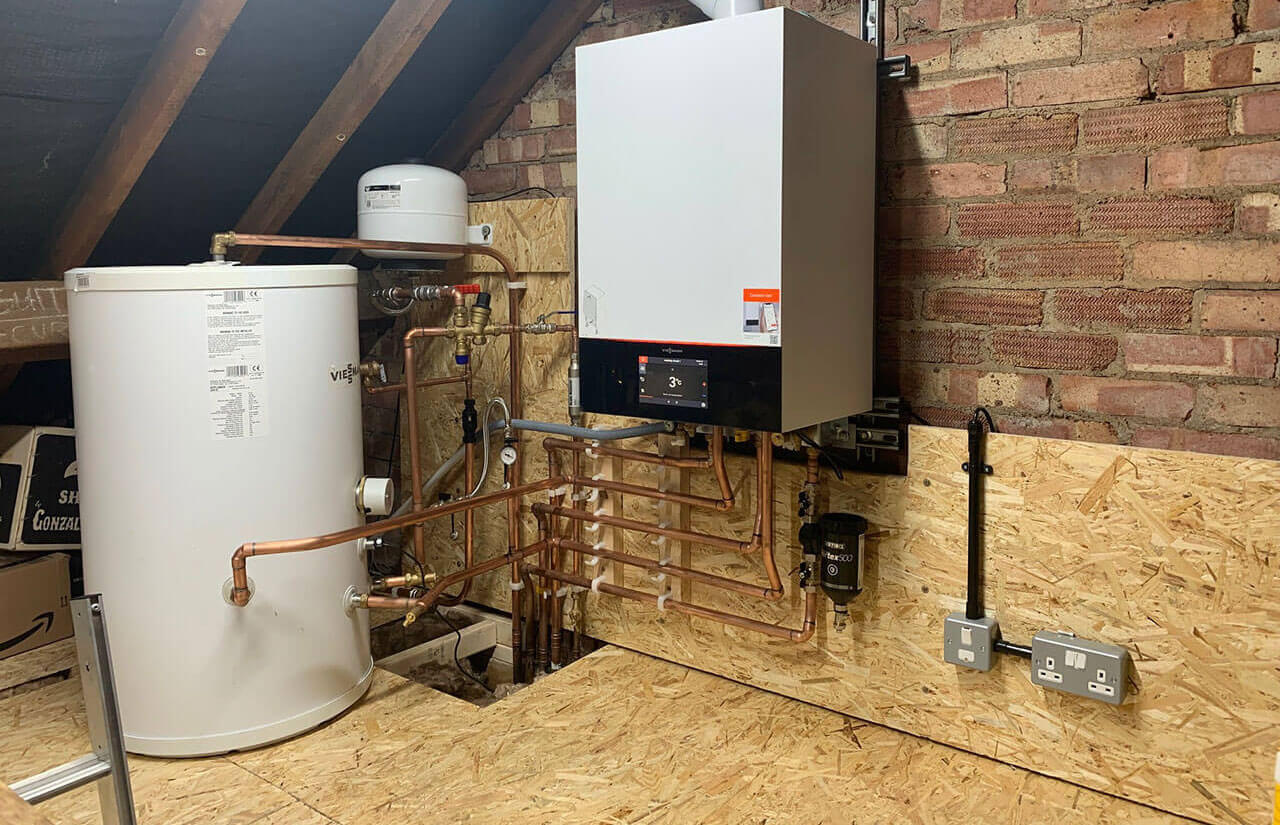
For homeowners in Belfast, the right replacement depends on factors such as the condition of the existing system, hot water demand, available space, boiler output, controls and the work needed to connect the new appliance.
This guide looks at the practical questions to consider before arranging a replacement, including the costs that may sit alongside the boiler itself.
Is replacing a combi boiler always a like-for-like job?
Not necessarily.
If the existing boiler is in a suitable position and the replacement uses compatible connections, the installation may be relatively straightforward. However, an installer should still assess the property rather than assuming that the existing arrangement is automatically suitable for a new appliance.
The assessment may consider:
- Current boiler output
- Heating and hot water demand
- Boiler location
- Existing pipework
- Flue arrangement
- Heating controls
- System condition
- Available access
- Whether the existing installation has recurring problems
A combi boiler replacement belfast project should therefore start with an assessment of the existing system rather than simply selecting a new appliance from a catalogue.
What signs suggest that a combi boiler may need replacing?
A fault does not automatically mean that a boiler needs to be replaced. Some problems can be repaired economically, while others may indicate that the appliance is reaching the end of its useful service life.
Signs worth discussing with a heating professional include:
- Frequent breakdowns
- Repeated repair bills
- Difficulty maintaining heating temperatures
- Unreliable hot water
- Unusual operating noises
- Persistent pressure problems
- Parts becoming difficult to source
- Increasing disruption from faults
The age and history of the boiler also matter. A single repair on an otherwise reliable appliance is very different from repeated failures over several years.
A professional assessment can help establish whether repair or replacement is the more appropriate route for the particular system.
How do you know what size replacement boiler you need?
Boiler output should be matched to the property’s requirements rather than selected simply because the replacement has a higher rating than the old appliance.
An installer may consider:
- Property size
- Number of rooms
- Heat loss
- Insulation levels
- Number of occupants
- Hot water demand
- Existing heating system
- Number and size of radiators
A larger boiler is not automatically more suitable. Oversizing can affect how the appliance operates, while an undersized boiler may struggle to meet demand.
This is one reason why a site assessment is valuable before committing to a replacement.
Does your household’s hot water demand matter?
Yes.
Combi boilers provide hot water directly rather than storing a large volume in a separate cylinder. As a result, the available hot water flow depends on factors including the boiler’s capability and the incoming mains water supply.
Consider how hot water is normally used in your home.
For example:
- Is more than one shower likely to be used at the same time?
- Are several taps commonly used together?
- Is there a large household?
- Has hot water demand increased since the existing boiler was installed?
If household usage has changed, the replacement should be considered around today’s requirements rather than simply copying the old specification.
Could your mains water pressure affect the replacement?
It can.
A combi boiler heats water as it passes through the appliance, so the performance of the hot water system is influenced by the incoming water supply and the property’s demand.
If you have noticed weak shower flow or slow hot water delivery, do not automatically assume that changing the boiler alone will solve the problem.
An installer can assess the relevant water supply conditions and explain whether they are suitable for the proposed replacement.
This is particularly useful before spending money on an appliance that may not address an underlying supply issue.
What happens to the existing pipework?
The existing pipework may be retained in part, but it should be assessed before installation.
The installer may identify sections that need alteration because of:
- The new boiler’s connections
- Different boiler dimensions
- Changes in boiler position
- Existing pipework condition
- System requirements
- Previous installation modifications
A like-for-like replacement does not necessarily mean every existing component should be left untouched.
Where changes are required, these should ideally be identified during the survey and reflected in the quotation.
Could replacing the boiler be a good time to upgrade the controls?
It can be worth discussing.
Heating controls determine how the system is operated and can influence how easily you manage heating throughout the day.
Depending on the existing setup, a replacement project may provide an opportunity to review:
- Programmers
- Thermostats
- Heating zones
- Temperature settings
- Control compatibility
The most appropriate arrangement depends on the property and the boiler being installed.
There is little benefit in adding features simply because they are available. The controls should provide useful functionality that suits how the household operates its heating.
What should you consider about the boiler’s location?
The existing location may be suitable, but this should be confirmed.
Check whether there is adequate space around the proposed appliance and whether the flue arrangement and connections can be accommodated appropriately.
If you want to move the boiler, the project can become more involved.
Relocation may affect:
- Pipework
- Flue routing
- Condensate arrangements
- Electrical connections
- Access
- Installation time
- Overall project cost
If you are considering a different location, raise this during the initial assessment rather than after the quotation has been agreed.
What makes up the boiler replacement cost?
The boiler replacement cost depends on much more than the appliance itself.
Potential elements include:
|
Cost factor |
Why it can affect the total |
|
New boiler |
Model, output and specification |
|
Labour |
Time and complexity of installation |
|
Controls |
Replacement or upgraded controls |
|
Pipework |
Alterations required for the new appliance |
|
Flue |
Changes to the existing arrangement |
|
Removal |
Disconnection and disposal of old equipment |
|
Location |
Additional work if the boiler is moved |
|
System work |
Other changes identified during assessment |
|
Commissioning |
Testing and setting up the new system |
Not every project will require all these items.
The most useful way to understand the price is to ask for a clear quotation that separates the main components of the work.
Is boiler replacement cost lower when the new boiler stays in the same position?
It can be, but there is no universal saving.
Keeping the boiler in the same location may reduce the amount of pipework or associated work required, particularly where the existing position is suitable and the connections can be adapted without major changes.
However, the condition of the current system and compatibility of the new appliance still need to be considered.
A homeowner should therefore avoid assuming that a like-for-like replacement will always have a particular price. The property assessment determines what work is actually necessary.
What should you ask before accepting a replacement quotation?
Before agreeing to the work, ask the installer to explain the complete proposal.
Useful questions include:
- Why is this boiler suitable for my home?
- What output has been recommended?
- Will the existing boiler position be retained?
- Does any pipework need to be changed?
- Are new controls included?
- Has the flue arrangement been assessed?
- Is the old boiler being removed?
- Is commissioning included?
- What could cause the final cost to change?
- What documentation will I receive after installation?
Clear answers can make the replacement process much easier to understand.
Should you replace the boiler before it breaks down completely?
There is no single answer.
If an older appliance is becoming unreliable and repairs are increasingly frequent, planning ahead can give you more time to compare options and arrange the work at a convenient point.
On the other hand, an otherwise reliable boiler may continue to provide useful service after a relatively minor repair.
The decision should take account of the boiler’s age, condition, repair history, reliability and likely future maintenance requirements.
Planning ahead can be particularly useful if a replacement would be disruptive or if the household depends heavily on the heating system.
What should a professional combi replacement involve?
A typical replacement may follow a sequence such as:
1. Assessment
The installer reviews the existing boiler and heating system.
2. Recommendation
A suitable boiler and output are identified based on the property.
3. Quotation
The proposed equipment and installation scope are documented.
4. Preparation
The work area and any required materials are prepared.
5. Removal
The existing boiler is disconnected and removed as agreed.
6. Installation
The replacement appliance and associated components are fitted.
7. Testing and commissioning
The system is checked and set up for operation.
8. Handover
The homeowner receives relevant information and guidance on using the new system.
The exact sequence can vary depending on the property.
What if a combi boiler is no longer suitable for your home?
A replacement project does not always have to involve another combi boiler.
If household requirements have changed, it may be appropriate to discuss alternative heating and hot water arrangements with a qualified installer.
For example, a larger household may have different hot water requirements from when the existing system was first installed.
The important point is to assess the property and usage before choosing the replacement system.
Final Thoughts
Replacing a combi boiler is an opportunity to look at the entire heating system rather than simply swapping one appliance for another.
For Belfast homeowners, consider the boiler’s output, hot water demand, mains water supply, pipework, controls, location and installation requirements before making a decision. A detailed assessment can help establish what needs to change and what can remain.
Understanding the boiler replacement cost also becomes easier when the quotation clearly explains the equipment, labour and additional work involved.
If your current boiler is becoming unreliable, planning the replacement before a complete breakdown can give you more time to understand your options.
Related articles
Which fuel powers your boiler?
At a glance
For homeowners in Belfast, the right replacement depends on factors such as the condition of the existing system, hot water demand, available space, boiler output, controls and the work needed to connect the new appliance.
This guide looks at the practical questions to consider before arranging a replacement, including the costs that may sit alongside the boiler itself.
Is replacing a combi boiler always a like-for-like job?
Not necessarily.
If the existing boiler is in a suitable position and the replacement uses compatible connections, the installation may be relatively straightforward. However, an installer should still assess the property rather than assuming that the existing arrangement is automatically suitable for a new appliance.
The assessment may consider:
- Current boiler output
- Heating and hot water demand
- Boiler location
- Existing pipework
- Flue arrangement
- Heating controls
- System condition
- Available access
- Whether the existing installation has recurring problems
A combi boiler replacement belfast project should therefore start with an assessment of the existing system rather than simply selecting a new appliance from a catalogue.
What signs suggest that a combi boiler may need replacing?
A fault does not automatically mean that a boiler needs to be replaced. Some problems can be repaired economically, while others may indicate that the appliance is reaching the end of its useful service life.
Signs worth discussing with a heating professional include:
- Frequent breakdowns
- Repeated repair bills
- Difficulty maintaining heating temperatures
- Unreliable hot water
- Unusual operating noises
- Persistent pressure problems
- Parts becoming difficult to source
- Increasing disruption from faults
The age and history of the boiler also matter. A single repair on an otherwise reliable appliance is very different from repeated failures over several years.
A professional assessment can help establish whether repair or replacement is the more appropriate route for the particular system.
How do you know what size replacement boiler you need?
Boiler output should be matched to the property’s requirements rather than selected simply because the replacement has a higher rating than the old appliance.
An installer may consider:
- Property size
- Number of rooms
- Heat loss
- Insulation levels
- Number of occupants
- Hot water demand
- Existing heating system
- Number and size of radiators
A larger boiler is not automatically more suitable. Oversizing can affect how the appliance operates, while an undersized boiler may struggle to meet demand.
This is one reason why a site assessment is valuable before committing to a replacement.
Does your household’s hot water demand matter?
Yes.
Combi boilers provide hot water directly rather than storing a large volume in a separate cylinder. As a result, the available hot water flow depends on factors including the boiler’s capability and the incoming mains water supply.
Consider how hot water is normally used in your home.
For example:
- Is more than one shower likely to be used at the same time?
- Are several taps commonly used together?
- Is there a large household?
- Has hot water demand increased since the existing boiler was installed?
If household usage has changed, the replacement should be considered around today’s requirements rather than simply copying the old specification.
Could your mains water pressure affect the replacement?
It can.
A combi boiler heats water as it passes through the appliance, so the performance of the hot water system is influenced by the incoming water supply and the property’s demand.
If you have noticed weak shower flow or slow hot water delivery, do not automatically assume that changing the boiler alone will solve the problem.
An installer can assess the relevant water supply conditions and explain whether they are suitable for the proposed replacement.
This is particularly useful before spending money on an appliance that may not address an underlying supply issue.
What happens to the existing pipework?
The existing pipework may be retained in part, but it should be assessed before installation.
The installer may identify sections that need alteration because of:
- The new boiler’s connections
- Different boiler dimensions
- Changes in boiler position
- Existing pipework condition
- System requirements
- Previous installation modifications
A like-for-like replacement does not necessarily mean every existing component should be left untouched.
Where changes are required, these should ideally be identified during the survey and reflected in the quotation.
Could replacing the boiler be a good time to upgrade the controls?
It can be worth discussing.
Heating controls determine how the system is operated and can influence how easily you manage heating throughout the day.
Depending on the existing setup, a replacement project may provide an opportunity to review:
- Programmers
- Thermostats
- Heating zones
- Temperature settings
- Control compatibility
The most appropriate arrangement depends on the property and the boiler being installed.
There is little benefit in adding features simply because they are available. The controls should provide useful functionality that suits how the household operates its heating.
What should you consider about the boiler’s location?
The existing location may be suitable, but this should be confirmed.
Check whether there is adequate space around the proposed appliance and whether the flue arrangement and connections can be accommodated appropriately.
If you want to move the boiler, the project can become more involved.
Relocation may affect:
- Pipework
- Flue routing
- Condensate arrangements
- Electrical connections
- Access
- Installation time
- Overall project cost
If you are considering a different location, raise this during the initial assessment rather than after the quotation has been agreed.
What makes up the boiler replacement cost?
The boiler replacement cost depends on much more than the appliance itself.
Potential elements include:
|
Cost factor |
Why it can affect the total |
|
New boiler |
Model, output and specification |
|
Labour |
Time and complexity of installation |
|
Controls |
Replacement or upgraded controls |
|
Pipework |
Alterations required for the new appliance |
|
Flue |
Changes to the existing arrangement |
|
Removal |
Disconnection and disposal of old equipment |
|
Location |
Additional work if the boiler is moved |
|
System work |
Other changes identified during assessment |
|
Commissioning |
Testing and setting up the new system |
Not every project will require all these items.
The most useful way to understand the price is to ask for a clear quotation that separates the main components of the work.
Is boiler replacement cost lower when the new boiler stays in the same position?
It can be, but there is no universal saving.
Keeping the boiler in the same location may reduce the amount of pipework or associated work required, particularly where the existing position is suitable and the connections can be adapted without major changes.
However, the condition of the current system and compatibility of the new appliance still need to be considered.
A homeowner should therefore avoid assuming that a like-for-like replacement will always have a particular price. The property assessment determines what work is actually necessary.
What should you ask before accepting a replacement quotation?
Before agreeing to the work, ask the installer to explain the complete proposal.
Useful questions include:
- Why is this boiler suitable for my home?
- What output has been recommended?
- Will the existing boiler position be retained?
- Does any pipework need to be changed?
- Are new controls included?
- Has the flue arrangement been assessed?
- Is the old boiler being removed?
- Is commissioning included?
- What could cause the final cost to change?
- What documentation will I receive after installation?
Clear answers can make the replacement process much easier to understand.
Should you replace the boiler before it breaks down completely?
There is no single answer.
If an older appliance is becoming unreliable and repairs are increasingly frequent, planning ahead can give you more time to compare options and arrange the work at a convenient point.
On the other hand, an otherwise reliable boiler may continue to provide useful service after a relatively minor repair.
The decision should take account of the boiler’s age, condition, repair history, reliability and likely future maintenance requirements.
Planning ahead can be particularly useful if a replacement would be disruptive or if the household depends heavily on the heating system.
What should a professional combi replacement involve?
A typical replacement may follow a sequence such as:
1. Assessment
The installer reviews the existing boiler and heating system.
2. Recommendation
A suitable boiler and output are identified based on the property.
3. Quotation
The proposed equipment and installation scope are documented.
4. Preparation
The work area and any required materials are prepared.
5. Removal
The existing boiler is disconnected and removed as agreed.
6. Installation
The replacement appliance and associated components are fitted.
7. Testing and commissioning
The system is checked and set up for operation.
8. Handover
The homeowner receives relevant information and guidance on using the new system.
The exact sequence can vary depending on the property.
What if a combi boiler is no longer suitable for your home?
A replacement project does not always have to involve another combi boiler.
If household requirements have changed, it may be appropriate to discuss alternative heating and hot water arrangements with a qualified installer.
For example, a larger household may have different hot water requirements from when the existing system was first installed.
The important point is to assess the property and usage before choosing the replacement system.
Final Thoughts
Replacing a combi boiler is an opportunity to look at the entire heating system rather than simply swapping one appliance for another.
For Belfast homeowners, consider the boiler’s output, hot water demand, mains water supply, pipework, controls, location and installation requirements before making a decision. A detailed assessment can help establish what needs to change and what can remain.
Understanding the boiler replacement cost also becomes easier when the quotation clearly explains the equipment, labour and additional work involved.
If your current boiler is becoming unreliable, planning the replacement before a complete breakdown can give you more time to understand your options.
